Showing posts with label Blackheath School of Art. Show all posts

Friday, 14 February 2025

Harold Nelson and the Ladies' Field - Masks and Faces

There are many columns that Nelson created decorative headings for and one of the first I was aware of was Masks and Faces...

This was a weekly column that included details and gossip about actors in professional theatre productions as opposed to the pieces dedicated to amateur theatre. 

Nelson designed a Renaissance style figure (actor?) and some classical style masks with the usual scroll announcing the title of the column. The figure is in the centre looking proudly toward the masks that he may well wear in his performance.

A sketch survives for the masks... which appear to be very similar to the final design albeit moved to the left, separated from the text. Originally Nelson conceived that the masks of Comedy and Tragedy would inhabit the whole design, although probably in the end deciding that this was too complicated and would not translate well to a wider page.

Harold Nelson, Masks and Faces (a sketch for the decorative heading for The Ladies' Field), about 1898.

Harold Nelson, Masks and Faces (final design printed in the Ladies' Field Magazine), November 1899.


The finished design is more interesting and fits better in the large page format of the magazine. It's also interesting as it is one of few designs that I come across that Nelson made for The Ladies' Field featuring a man on their own. Other designs for the magazine feature men and women or women on their own.
Of course I will be posting more in the future.
If you enjoy this please do check out my Instagram page devoted to Harold Nelson - @haroldnelson_artist 


Monday, 10 February 2025

Harold Nelson and The Ladies' Field Magazine

Harold Nelson was not just a bookplate artist or designer of stamps which is what he is mostly remembered for today. Nelson also produced illustrations for many magazines during the late nineteenth and early twentieth centuries.

One such publication was an early forerunner of Vogue, The Ladies’ Field. First published in 1898 as a weekly magazine for women, it came out on Saturdays from March 1898 to March 1922. It focused on many subjects of interest for the Victorian woman including sports, art, books, pets, fashion and many other things.

Nelson created many images for this publication between 1898 and at least 1910.

What will follow (in the coming weeks) are a selection of images, either designs drawn, printed decorative headings or covers, for the magazine. 

Harold Nelson, The Ladies' Field, 1898.


Let’s start with the logo for the magazine which regularly appeared on the introductory page behind the cover. An elegant Victorian woman holding flowers, wearing a coat emblazoned with lion rampant. Fleur de lys decorate the background with the scroll drawn over the background decoration. 

The woman is most definitely elegance personified and a perfect image for the magazine, perhaps even the ideal reader.


Tuesday, 1 August 2023


A Memorial to Emily Jane Morley

I think I have neglected this entry for long enough and it's about time that I start putting more of my work out there for people to read (if they wish).

One of the long serving members of staff at BSA was the needlework teacher, Emily Jane Morley. Morley was born on 27 November 1860, and her family home was in Rokeby Road in Brockley.[1] She appears as the needlework teacher in the BSA adverts in the Woolwich Gazette, offering classes on Tuesday mornings between 10.30am and 12.30pm and Thursday afternoons from 3pm to 4.30pm.[2]
Unfortunately I am yet to find an example of her work although judging from the reports of student works she was a highly respected teacher. Examples of comments over the year include the following:
1914 - ‘Arranged in the upper studio of the new wing may be seen numerous exquisite pieces of Art Needlework done by the pupils of Miss E.J. Morley.’[3]
1921 – ‘In the needlework section, where the quality of work has always been excellent…’[4]
1923 – 6 October 1923 – students’ exhibition review
The 1921 prospectus described Art Needlework classes as follows (it was at this time a subject studied only by women) –
‘Students are taught the various Stitches etc., which belong to Embroidery, Drawn Thread and Lace Work, also the application to various articles of daily use and ladies’ apparel’.[5]
Morley lived at 11 Lee Park, very close to BSA, with her assistant and companion Lilian Booth. Emily Morley died on 10 June 1925 and whilst I have not yet found any illustrations of her works there is still a memorial in Blackheath that relates to her. Morley’s funeral was held on Monday 15 June 1925 at St Michael and All Angels in Blackheath and the internment at Nunhead Cemetery.[6] One of the principal mourners was her companion and assistant Lilian Booth. Morley was a very highly regarded member of the teaching staff at BSA, the school was closed on the day of her funeral as a measure of respect.[7] The principal, John Howard Hale, the secretary EP Lewis and the registrar Mrs Dowling represented the school as well as many students of BSA both past and present. The principal and committee of BSA presented a wreath in the ‘form of a chaplet’ and her colleagues and students presented a wreath in the form of a palette.[8]


Memorial to Emily Jane Morley carved by BSA students, St Michael's, Blackheath.
Source: Thanks to St Michael's Blackheath for allowing me to photograph and publish this image.

The memorial to her was to be unveiled on 16 June 1927 at 6pm in St Michael’s, Blackheath.[9] This wood carved epitaph was created by students at BSA. Woodworking students were taught by Mr F Parrott. From the descriptions provided in the contemporary prospectuses I believe that the students who produced the beautifully carved memorial were studying under Parrott as the lettering classes do not refer to the use of carving as part of the students’ learning.
I hope at some point to discover some needlework made by Morley but until then this memorial remains a tangible memory of her work at BSA.


[1] She was baptised on 23 December 1860, and the family home was at 13 Rokeby Road, Brockley and her father Alfred was a stationer.
[2] ‘Government School of Art’, in Woolwich Gazette, Fri 10 Jun 1898, p. 4 and Fri 16 Mar 1900, p. 4.
[3] ‘Blackheath School of Art: Exhibition of Students’ Works’ in Blackheath Local Guide, 26 September 1914, p. 8.
[4] ‘Blackheath School of Art: Student Exhibition’ in Blackheath Local Guide, 21 October 1921, p. 37.
[5] Blackheath, Lee, Lewisham & Greenwich School of Arts and Crafts Prospectus, 1920 – 1921, p. 14. Morley taught classes during the day Tue 10am to 1pm and 2.30pm to 4.30pm, Thu 2.30pm to 4.30pm and Fri 10.30am to 12.30pm, and in the evening Mon 6.30pm to 8.30pm and Tues to Thu 7pm to 9pm.
[6] ‘Funeral of Miss Morley’, in Blackheath Local Guide, 25 June, p. 36.
[7] Ibid.
[8] Loc. cit. pp. 36 & 37.
[9] ‘St Michael’s, Blackheath Park’, in Blackheath Local Guide, 11 Jun 1927, p. 6. The unveiling was in conjunction with a day dedicated to missionary work in China undertaken by members of the congregation.

Thursday, 6 April 2023

Would you have these two over to dinner?


Humour and wit in the art of Alfred de Sauty…

Alfred de Sauty, Coming Over, early 1930's.

I recently acquired this print by Alfred de Sauty entitled ‘Coming Over’ and it reminded me that I had been meaning to write a piece about his humorous side.

 These two are obviously on the way over to a neighbour’s house for dinner. Are they providing the food or is the way so treacherous that they need a gun to ensure that they make it there safely!? Either way it’s a witty comment on the nature of community in the wilds of the US. The print is dedicated to ‘Mr and Mrs RP Brown from A De Sauty’ – could the couple perhaps have inspired De Sauty? I guess it may never be possible to discover this, although it is fun to speculate.


Alfred de Sauty, The Proposal, 1930's.

Alfred de Sauty, Matrimony, 1930's.

Alfred de Sauty, Divorce, 1930's

Alfred de Sauty, The Proposal, Matrimony and Divorce, 1930's.

During lockdown I was emailed these three intriguing images which join to form a series. It’s s satirical comment on the nature of business deals. It may well relate to the cut throat nature of the way of doing business, a kind of brashness that De Sauty would not have experienced first-hand before he went to Chicago in Autumn 1923. I would date this work from the early to the mid-1920’s, not long after he moved across the Atlantic. It matches the style of works he produced whilst still in the UK.

De Sauty produced three prints entitled The Proposal, Matrimony and Divorce, and have only just got back to looking at them (where does the time go?). These three works are related to business deals in America under 'marriage' related titles. Looking closely at 'Divorce' the money sacks have $ signs on them which confirms to me it is most likely a comment on business deals in America.


Alfred de Sauty, Floreat Chicago, 1935 or earlier, Smithsonian Museum.

They are quite similar in style to his brilliant depictions of the growing metropolis of Chicago which date to the mid 1930’s – about 10 years after his arrival in the US.

Could the businessman be a self-portrait (or a portrait of someone in particular)? The figure holding the gun (a man in a woman's dress) might be representative of a forced marriage / business deal at gunpoint. The businessman appears to be giving up everything to get the deal (even though he is at gun point). Of course, the woman isn't what she seems to be for the rather unusual gunpoint proposal and is depicted wearing high heels as part of the deceit. In the other two (Matrimony and Divorce) he / she is now wearing boots; perhaps revealing their true character.

The businessman is chained to the man / woman holding his goods (designs?) under his arm in Matrimony. Once the sinister the figure has got what they wanted (bags of dollars) they then divorce / break the deal with the businessman by kicking him away.

This could well be a comment on him finishing work at RR Donnelly & Sons (Lakeside Press) in Chicago but cannot be sure as there is very little known about De Sauty's personal life.


Rockwell Kent & Alfred de Sauty, De Sauty's Bad Dream, My Yours be Better, 1931.
More can be found about it through Underhill Books - here


De Sauty also worked closely with Rockwell Kent - and there is a piece signed by both De Sauty and Kent which makes me think that he had a rather wicked sense of humour (see above). Kent illustrated Moby Dick and De Sauty worked with Kent at the Lakeside Press binding his illustrated books (esp. N by E in 1930). The drawing shows various characters riding on and attacking Moby Dick and is a new year’s wish for the year ending 1930 and beginning 1931. Are the characters on the whale a part of De Sauty’s nightmare? ‘The piece is inscribed ‘De Sauty’s Bad Dream May Yours be better in 1931.’

Certainly, the seemingly brash world of American business deals and contracts at this time must have been something completely different to De Sauty's experiences in London. It must have affected him and inspired these fantastic images.


Saturday, 22 May 2021

Harold Nelson and depictions of Athena


Harold Nelson and depictions of Athena

Happy 150th birthday to Harold Nelson who was born on this day – 22 May – in 1871.

It’s been a while since I have added something to the blog and thought that it was about time that I got around to doing so. Nelson was best known in his lifetime as a black and white illustrator and ex-libris designer for wealthy clients and organizations.

One of my questions about his working method was whether he re-used image or had a design book that potential patrons could choose what they would like for their personalized ex-libris. He did indeed re-use images which I will delve into further detail at a later date. I have decided on this occasion to focus on his images of Athena, the goddess of wisdom and the arts, she was the counsel of Odysseus during his Odyssey. At the time of the French Revolution Athena began to stand for Freedom and Liberty.

Nelson depicted Athena a number of times through his career and must have been interested in depicting her as she had become seen as the Goddess of the Arts. I have included some examples below from sketches, design drawings and finally to ex libris bookplates.


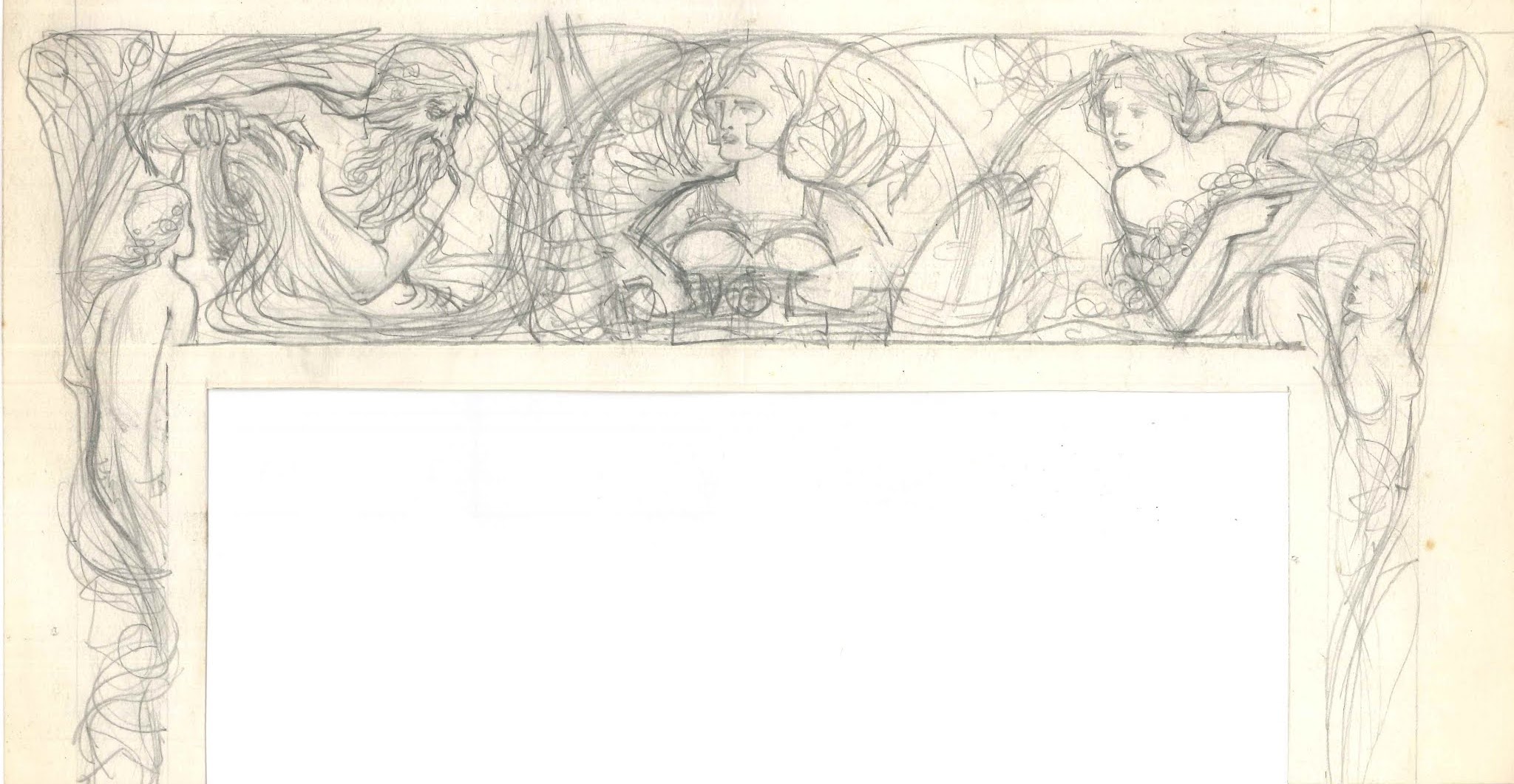
This exquisite drawing features Athena in the centre flanked by water nymphs. I am not entirely sure whether this was later developed into a finished image.


Design drawing for the Strand Magazine. Here Athena, in armour ready for battle, is depicted to the right of the drawing. Below Athena is written ‘Fact’ an allusion that she stands for wisdom and knowledge. I am unsure whether this design was ever used in print.


A sketch for Athena (most likely to have made for an ex-libris design for a library or book collector), depicted holding a book and a spear. Behind her are the leaves of the olive tree.


This image of Athena with her sword and lantern was also used by Nelson for the National Union of Teachers. Athena is entwined in an olive tree, representative of the one that grew on the Acropolis. The scroll behind Athena has ‘Vince Fide’ (Conquer with Faith) inscribed on it.


Here is the above image used as the logo for The National Union of Teachers. The main discernible difference is the inscription on the scroll. As they are undated I am not entirely sure which came first.


This is such an appropriate representation of Athena for the Bedford College Library. Here she is within an olive tree with an owl on her right shoulder and a lantern in her left hand. Books, source of knowledge, are scattered at the bottom of the ex-libris.


This is a more serious stoic representation of Athena for a potential ex-libris patron as there is no name included in the design (it is included in Nelson’s 1929 volume of bookplates). Athena holds a shield and spear, standing in front of classical architecture (the Acropolis?) and an owl appears in an olive branch in front of the goddess.


As these images are all from my own collection, I am sure there must be other variations in existence from Nelson’s career. Hopefully I can add other images as I discover them. His works are quite accessible and a good way to get into black and white illustration in late nineteenth and early twentieth century Britain.


Thursday, 10 January 2019


Pre-war aeroplane drawings from the Blackheath School of Art

Among the collection of art works at the Conservatoire are three colour pencil drawings of aeroplanes. These have captured their time perfectly, representing not only aircraft and fashion of the late 1930’s but also of an artistic style that owes a lot to graphic design of the era. The simple metal frames do seem to be later, likely from the 1960’s or 1970’s, however the pictures do seem to be a lot older as will be discussed below. [1]
These drawings most likely date from the period 1937 to 1940 before the art school closed to be annexed by the army pay corps in 1940. Whilst I have found the source photographs for two of the drawings we have yet to discover the source for the third drawing.

Heracles

Heracles at Croydon Airport pre 1940.

Unknown artist, Drawing After British Airways promotional photograph of Heracles, colour pencil on paper, before 1940.

The first drawing depicts Imperial Airways plane Handley Page HP42 GAAXC, Heracles, at Croydon airport. As with the other pictures, the colours remain vibrant with simple lines and shading portraying a stylistic representation of a late 1930’s airport complete with pilots and passengers. Imperial Airways merged to become a part of British Overseas Airways Corporation (BOAC) in 1939 which was eventually the company known as British Airways in 1974. Heracles first flew in 1931 and was pressed into war service with the RAF on 3 March 1940 and only lasted 16 days before it was destroyed in a gale at Whitchurch airport, Bristol, after being blown into another plane, Hanno. Both planes were damaged beyond repair.


Douglas DST144


Press photograph:  The Launch of American Airlines’ Flagship, Texas at Grand Central Airport, Glendale 1937


Unkown artist, The Launch of American Airlines’ Flagship, Texas at Grand Central Airport, Glendale 1937, colour pencil on paper before 1940.


The other is a depiction of American Airlines plane, Texas, at Grand Central Airport, Los Angeles (above right) with passengers waiting to board on the left and soldiers loading/ unloading the plane to the left of the picture. A Douglas DST144 aeroplane press photo dated 1937 is the source of this drawing. This was the aeroplane which significantly cut down the travel time from the west coast to the east coast of the USA from with the Texas in service in late 1935. [2] 
The artist added extra figures and trucks to the right side of the drawing in order to make the composition more balanced. Even though the work is essentially a copy these extra details show that the artist possessed some skill and imagination.


Dornier Merkur D1104


Unkown artist, Dornier Merkur D1104, colour pencil on paper, before 1940.


Detail of above showing pilot and passengers.

The third drawing in the series is an illustration of the Dornier Merkur D1104 plane which was built in the late 1930’s. The technique and style of this picture shows the influence of the eminent British designers and illustrators of this period: Charles Paine (who taught at the Blackheath School of Art in the early 1930’s), Eric Ravilious (official war artist), Edward Bawden (who did some advertising work for Imperial Airways) and Barnett Freedman (a prominent designer at this time who was a visiting lecturer at BSA). During this period at BSA there were a large number of students who were very skilled at creating posters and advertisements studying under Paine (see my previous entry on Charles Paine). Paine and Douglas Bliss taught Commercial Art at the school in the 1930's. The 1931 / 1932 prospectus listed the subjects that the course would concentrate on:
Training as Commercial Artists or Illustrators: Drawing from Life, Figure Designs and Composition, Painting from Life, Poster Design, Lettering and Writing, Heraldry, Costume, Black and White Drawing, Book Illustration and Decoration, Wood Engraving, Study of Historic and Modern Art, Methods of Reproduction, Study of the business requirements of Commercial Art. [3]
One student in the early 1930's, who later studied at Central St Martin's, Richard Wakeford was noted as having designs accepted by Canadian Pacific. [4]


Unlike the other two drawings I have not yet been able to discover a photograph of this plane or whether there may a photograph that closely resembles this picture. Given that the other two pictures definitely were derived from photos the odds are that this too had its beginnings in photographic form.


[1] The label on the reverse is from Framery Ltd, 39 Blandford Street, London, W1H 3AF. The telephone number shows that the label is from before 1990 but most likely the 1960's -  01-935 4838.
[2] The Vintage Air Photos blog contains an interesting entry on the history of the plane and detailed analysis of the photograph which inspired the drawing. See entry from Tuesday 6 August 2013 entitled Legends: Grand Central and the First DC-3.
[3] Blackheath, Lee, Lewisham and Greenwich School of Art and Crafts: Prospectus & Time Table Session 1931 - 1932 p. vi.
[4] ‘Blackheath School of Art’, in Blackheath Local Guide, 28 March, 1936, p. 6. Although Wakeford was a student at the school before 1937 (the date of the source photographs) this article shows that students were involved in designs for travel.


Saturday, 10 November 2018

Blackheath School of Art and art therapy for wounded soldiers in World War I


In the course of my reading about the history of the BSA I came across an article which described a scene that has remained with me from the moment I read it. It concerned a returning soldier standing, silently, neck deep in water in one of the Blackheath ponds. I can only scarcely imagine the awful predicament that he must have been in. What followed was a description that people just walked past him as if it was something strange and not doing anything about it. It took another soldier, passing by, to understand the distress the poor young man must have been suffering. He removed his coat and waded into the water to rescue him, made sure he was okay and then walked away.[1]

Bermondsey Military Hospital, Ladywell.
Source: more available here


Thankfully there were some positive stories relating to soldiers and their state of mind when returning from the Front. Just prior to the temporary move of the Blackheath School of Art to its temporary location at 5 Lee Terrace (opposite St Margaret’s, Lee) in September 1918 the annual students’ exhibition included works by soldiers returning from the Front. These soldiers had been injured and were recovering in Bermondsey Military Hospital in nearby Ladywell.

John Howard Hale, Principal of Blackheath School of Art, 1928.
Blackheath Local Guide, 21 July 1928, p. 14.


John Howard Hale, principal of BSA, worked closely with the medical officer in charge of the hospital, Lieutenant Colonel H Marrett Tims, using arts and crafts as a way to help rehabilitate soldiers. These classes began in the February of 1918 and despite initial worries about funding they ran and were very successful. Funding was secured from the British Red Cross through the hard work of the Mayor and Mayoress of Lewisham. It was Tims’ belief that the recovery of the soldiers would be hastened by undertaking creative craft work.

Bermondsey Military Hospital Christmas Card 1918 from H Marrett Tims and staff.


At the suggestion of Tims and John White, Hale was tasked with deciding on the classes and also recruiting teachers of the classes from the existing BSA staff and advanced students. The following subjects were decided upon as the most beneficial for the soldiers: bookbinding, woodcarving, metalwork, drawing, lettering and design  and needlework (including rug making). Recovering soldiers had been encouraged to undertake art earlier in 1916, at Johnson Hospital in Lincoln although I believe that the organised classes at Bermondsey Military Hospital were some of the first to be tailor made in order help with rehabilitation.[2]

According to the author of the article in the Blackheath Local Guide, it seemed like the expectations held for the classes succeeding (being popular) were not incredibly high. Through the expertise of the teachers and students recruited by Hale the scheme was incredibly popular with the patients. The soldiers were incredibly inspired by their immersion into the world of arts and crafts. The hard work of the instructors allowed an access to the creative process that many of the soldiers were either not familiar with or had never had the opportunity to utilise in the past.

Many of the soldiers stayed in touch with their instructors after they were discharged from the hospital. It also led to others becoming teachers of art when returning to their home countries. The outstanding success of the scheme was summed up by the following:
The scheme has succeeded almost beyond the sanguine expectations of its originator. The instructors, under his [Hale’s] inspiration and direction, threw themselves whole-heartedly into their work and found the soldiers apt and eager pupils. Whilst they received from Lieut-Col. Tims every encouragement. That the scheme, whilst recreative, was at the same time truly educative is shown by the fact that one man has already received an appointment as [a] teacher of wood-carving in South Africa.[3]

The soldiers were inspired by learning new skills and the teaching of the instructors that many of them kept in touch with their teachers after being discharged from the hospital. Others also expressed a wish for art lessons to continue in earnest in their home villages.[4] The instructors for these classes were taken from the teaching staff at the school and advanced students. Some of the students who helped were: Miss Butler, Miss Booth, Miss Cooke, Miss Harding and Miss White and the administrative work was taken up by the school’s registrar Mrs SW Dowling who acted as Honorary Secretary.[5] I haven’t yet been able to find out a lot about these students other than there was a Miss E White whose church book marks were praised in the 1916 students’ exhibition, as were the crocheted pieces by Miss Harding mentioned,[6] and a Mrs EB Cooke’s ceramic works were described as ‘striking’.[7]

Harold Nelson, Design for a Coat of Arms - given Nelson's proficiency with designing arms I can imagine that he helped soldiers with reproducing their crests.
Source: Collection of the author.


Teaching staff during these years included John Kerr (Design and Weaving), Emily Jane Morley (Needlework and Embroidery), Harold Nelson (Black and White Illustration), Mr R Toms (Metalwork), and Mr Edgar Green (Bookbinding). I would presume that some of the works included in the exhibition later held at the hospital included pieces by the teachers of the soldiers’ classes.

Advertisement for courses at BSA featuring details of the exhibition of the works of art created by wounded soldiers.
Blackheath Local Guide, 17 November 1918, p. 1.


Ten days after the Armistice an exhibition of the works made by the soldiers was opened by Lady Haig at the Bermondsey Military Hospital. Included among the soldiers’ works were pieces by their teachers which most likely included the teachers mentioned above from BSA staff and also the advanced students. The opening, on 21 November, received national coverage although the detail was very brief. The exhibition featuring in the Daily Record and Mail, the next day, was described as follows:
Lady Haig, in opening an exhibition of art and craft work by soldier patients at the Bermondsey Military Hospital yesterday, said that her husband’s one hope and one thought, now that the war was over, was for those who had who had been through fighting… She knew that his one aim and ambition in life was to see that those who had fought and suffered should come through all right.[8] 
Lady Haig was incredibly impressed by the quality of the works that were produced over such a short period of time.[9]

The exhibition was extremely popular with the works selling out very quickly. The soldiers were described as being very adept at needlework, I can imagine Emily Morley and Harold Nelson helping them with their depictions of company and squadron crests, these being understandably popular subjects. The works were ‘judged’ by Lady Robertson (a member of the BSA committee) the principal Hale, which makes me think that they gave awards to the soldiers (again sadly I have not found any record of these). Lady Robertson also expressed delight at the high quality of work on display.[10]

I am hopeful, that this might be the beginning of discovering more about an incredible period in the history of the Blackheath School of Art and its role in the rehabilitation of soldiers returning from the battlefields. Perhaps the last words should, for now, belong to the reviewer:
Every visitor must have been struck by the originality both of design and treatment displayed in the work; whether embroidery and needlework or jewellery, and metalwork or pottery and wood-carving. In execution, too, many of the articles on view were marked with a delicacy which one associates with the gentler sex. How highly those present at the Exhibition thought of the work was shown by the quick sale of all the exhibits.[11]


[1] I am usually very good at writing down references, but yet, for some reason I didn’t note the date or page number of the Blackheath Guide I was reading other than it was from 1915.
[2] The classes at Johnson Hospital are believed to have led to the founding of the Spalding Arts and Crafts Society - https://www.bbc.co.uk/programmes/p02b0vzt
[3] ‘Art and the Wounded Soldier’ in Blackheath Local Guide, 14 December 1918, p. 20.
[4] loc. cit., p. 21. Unfortunately there is no reference to specific names of soldiers or teachers.
[5] Blackheath Local Guide, 19 October, 1918, p. 14. The names appear in a brief review of the Students’ Exhibition.
[6] ‘Blackheath School of Arts and Crafts: Exhibition of Students’ Works’ in Blackheath Local Guide, 7 October 1916, p. 15 and ‘Blackheath School of Art: Exhibition of Students’ Works: Blackheath Local Guide, 26 September, 1914, p. 8. In 1914 Miss E White exhibited a processional banner featuring St Peter holding keys on a white ground destined for St Peter’s Church, Eltham. It was described as one of the more prominent works on display.
[7] Blackheath Local Guide, 27 September 1919, p. 24. ‘Nor has the Potter’s wheel been idle. Specimens of pottery thrown, baked, decorated, glazed and fired including some striking work by Mrs EB Cooke.’
[8] ‘Sir D. Haig’s One Ambition’, in Daily Record and Mail, Friday 22 November, 1918, p. 5.
[9] Blackheath Local Guide, 14 Dec 1918, p. 21.
[10] ibid.
[11] loc. cit. pp. 21 – 22.