Showing posts with label prints. Show all posts

Thursday, 6 April 2023

Would you have these two over to dinner?


Humour and wit in the art of Alfred de Sauty…

Alfred de Sauty, Coming Over, early 1930's.

I recently acquired this print by Alfred de Sauty entitled ‘Coming Over’ and it reminded me that I had been meaning to write a piece about his humorous side.

 These two are obviously on the way over to a neighbour’s house for dinner. Are they providing the food or is the way so treacherous that they need a gun to ensure that they make it there safely!? Either way it’s a witty comment on the nature of community in the wilds of the US. The print is dedicated to ‘Mr and Mrs RP Brown from A De Sauty’ – could the couple perhaps have inspired De Sauty? I guess it may never be possible to discover this, although it is fun to speculate.


Alfred de Sauty, The Proposal, 1930's.

Alfred de Sauty, Matrimony, 1930's.

Alfred de Sauty, Divorce, 1930's

Alfred de Sauty, The Proposal, Matrimony and Divorce, 1930's.

During lockdown I was emailed these three intriguing images which join to form a series. It’s s satirical comment on the nature of business deals. It may well relate to the cut throat nature of the way of doing business, a kind of brashness that De Sauty would not have experienced first-hand before he went to Chicago in Autumn 1923. I would date this work from the early to the mid-1920’s, not long after he moved across the Atlantic. It matches the style of works he produced whilst still in the UK.

De Sauty produced three prints entitled The Proposal, Matrimony and Divorce, and have only just got back to looking at them (where does the time go?). These three works are related to business deals in America under 'marriage' related titles. Looking closely at 'Divorce' the money sacks have $ signs on them which confirms to me it is most likely a comment on business deals in America.


Alfred de Sauty, Floreat Chicago, 1935 or earlier, Smithsonian Museum.

They are quite similar in style to his brilliant depictions of the growing metropolis of Chicago which date to the mid 1930’s – about 10 years after his arrival in the US.

Could the businessman be a self-portrait (or a portrait of someone in particular)? The figure holding the gun (a man in a woman's dress) might be representative of a forced marriage / business deal at gunpoint. The businessman appears to be giving up everything to get the deal (even though he is at gun point). Of course, the woman isn't what she seems to be for the rather unusual gunpoint proposal and is depicted wearing high heels as part of the deceit. In the other two (Matrimony and Divorce) he / she is now wearing boots; perhaps revealing their true character.

The businessman is chained to the man / woman holding his goods (designs?) under his arm in Matrimony. Once the sinister the figure has got what they wanted (bags of dollars) they then divorce / break the deal with the businessman by kicking him away.

This could well be a comment on him finishing work at RR Donnelly & Sons (Lakeside Press) in Chicago but cannot be sure as there is very little known about De Sauty's personal life.


Rockwell Kent & Alfred de Sauty, De Sauty's Bad Dream, My Yours be Better, 1931.
More can be found about it through Underhill Books - here


De Sauty also worked closely with Rockwell Kent - and there is a piece signed by both De Sauty and Kent which makes me think that he had a rather wicked sense of humour (see above). Kent illustrated Moby Dick and De Sauty worked with Kent at the Lakeside Press binding his illustrated books (esp. N by E in 1930). The drawing shows various characters riding on and attacking Moby Dick and is a new year’s wish for the year ending 1930 and beginning 1931. Are the characters on the whale a part of De Sauty’s nightmare? ‘The piece is inscribed ‘De Sauty’s Bad Dream May Yours be better in 1931.’

Certainly, the seemingly brash world of American business deals and contracts at this time must have been something completely different to De Sauty's experiences in London. It must have affected him and inspired these fantastic images.


Saturday, 12 May 2018


Exhibition of art works from the Contemporary Art Society at the Blackheath School of Art in 1934


From 5 to 10 February 1934, a loan exhibition of recent acquisitions from the Contemporary Art Society was held at the Blackheath School of Art. This was the first temporary exhibition that I came across in the course of learning more about the history of the school. The exhibition was opened by the local painter Francis Dodd, and his speech provided advice to the students in the art of drawing and the style of depiction.[1] The display was promoted as having immense value for the students being able to view works by modern artists up close. The residents of Blackheath who also found the exhibition beneficial ‘were given the opportunity of seeing in their own immediate neighbourhood an exhibition of a standard rarely available outside of Bond-street’.[2]

One hundred works, comprising of recent acquisitions by the society, formed a part of a touring exhibition which, in addition to Blackheath, also visited City Art Gallery, Leeds, St Marylebone Town Hall, Laing Art Gallery, Newcastle-upon-Tyne, City Art Gallery, Manchester and Corporation Art Gallery, Carlisle.[3]

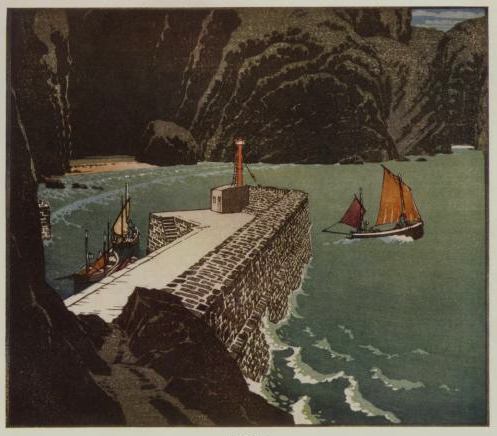
The works for the exhibition were chosen by the keeper of Prints and Drawings at the British Museum, Campbell Dodgson and the display of the works of art arranged by the principal John Platt. Two of Platt’s works were acquired as a part of the Print Fund in 1934, they were Red Bull and Mullion Cove, both of which featured in the exhibition at Blackheath School of Art. Additionally the list of acquisitions from 1934 feature works by another teacher at Blackheath including woodcuts by Douglas Bliss, Illustrations to the Devil in Scotland.[4] Acquisitions from the immediate two preceding years included prints by Platt, Mullion Cove and The Echoing Shore,[5] and Robert Austin, Still LIfe, Perugia.[6]

Works on display in the exhibition included:
Dame Laura Knight – Gemini - more here
Pearl Binder – Wentworth Street - more here
Ludwig Heinrich Jungnickel – Jagua
Anna Findlay – The Paper Mill - you can find out more about Anna Findlay from the excellent Modern Printmakers blog - here


Joseph Simpson – George Bernard Shaw, etching, 1929. The British Museum, 1941,0208.92.
Source: The British Museum.


John Edgar Platt – Mullion Covemore here

John Edgar Platt, Red Bull - more here
Source: http://woodblock.com/platt/
John Edgar Platt – The Echoing Shoremore here
Source: http://woodblock.com/platt/

Most of the above works were acquisitions from 1932 or 1933.

Works acquired by the CAS by Robert Austin and Douglas Bliss can be seen below.

Robert Austin, Still Life, Perugia, etching, 1932, Minneapolis Institute of Art. Gift of Robert Austin's Daughters Rachel and Clare 2013.70.37. A version of this print was acquired by the Contemporary Art Society in 1933 and gifted to the Victoria and Albert Museum.
Source: Minneapolis Institute of Art.
Douglas Bliss, Wandering Willie's Tale, from The Devil in Scotland.
Source: Collection of the author.

Douglas Bliss, Thrawn Janet image from the Title page, from The Devil in Scotland.
Source: Collection of the author. A book featuring prints from the Devil in Scotland was given to the British Museum by the Contemporary Art Society in 1934. Whether this book was included in the exhibition at Blackheath School of Art is unknown.
Having Blackheath as one of the venues for this touring exhibition was a coup for the students of the school and the locals alike. John Platt's contacts in the art world enabled him to organise interesting exhibitions during his time as principal from 1929 to 1940. This is intended to be the first in a series of entries on the exhibitions held at the Blackheath School of Art in the 1930's.


[1] ‘Loan exhibition of recent acquisitions of the Contemporary Art Society’ in Blackheath Local Guide, 17 February, 1934, p 11. The concluding passage of Dodd’s opening speech advised students that whilst looking at the drawings on display ‘that the best drawing was the one they saw with their minds’ eyes before they began to touch paper, for it was extremely difficult to do anything in a perfect manner.’
[2] loc. cit., p. 10.  Students were able to use their analytical skills to ascertain the technical skills which would have been very valuable for their development.
[3] Contemporary Art Society Report, 1934 - 1935, p. 29. The exhibition featured over 100 prints and drawings which were recent acquisitions.
[4] loc. cit., p. 30. I am unsure as to whether this work was acquired pre Feb 1934 for it to be included in the exhibition.
[5] Contemporary Art Society Report, 1932 – 1933, p. 33. Whether the CAS acquired two versions of Mullion Cove (one in 1932 and the other in 1934) is yet to be ascertained.
[6] loc. cit., p. 34. Robert Austin taught at BSA in the mid 1920’s.