Sunday, 17 June 2018


Charles Paine: Commercial Art and Design legacy at Blackheath School of Art


I have been meaning to write something about Charles Paine and his time at the Blackheath School of Art for some time now. Many of his works were auctioned by Bamfords in 2015, including original sketches, paintings and posters. In amongst these also were his archives, started by Paine by also added to by his family. I have been privileged enough to be able to look through these. My sincere thanks go to Adrian at Darnley Fine Art for allowing me to read through this fascinating collection.

Charles Paine was born on 23 October, 1895 in Pendleton, Salford. He began his studies at Salford School of Art[1] and continued further studies at Manchester School of Art.[2] I won’t continue to write about his life other than his time at the Blackheath School of Art as the excellent Charles Paine blog has covered his life in far more detail than I could ever be capable of. You can read more about it here (it is a highly recommended read for anyone interested in Paine or the history of design in Britain).

Paine’s connection with the Blackheath School of Art began in 1929; two years before he started teaching Design at BSA his works were displayed as a part of the Modern Posters exhibition. This provides evidence of the friendship between Paine and Platt, a subject which will be discussed in further detail later. The works exhibited by Paine (most likely Underground designs given references to the subject matter of some of the other posters) ‘show[ed] a delightful playful fancy and charming colour. There is something essentially English in his gay little figures and flowers’.[3]


Charles Paine, Barnet by Tram, 1922, Art Institute of Chicago, Gift of London Underground Railway, 1924 1023.
Source - Art Institute of Chicago


Charles Paine, Kingston by Tram, 1920, Art Institute of Chicago, RX21447/226.
Source: Art Institute of Chicago
Charles Paine, Hampton Court, 1921, Art Institute of Chicago, RX21447/228.
Source: Art Institute of Chicago 


Charles Paine started at BSA in September 1931 and his appointment at the school was lauded by the Blackheath Local Guide on 19 September 1931. There was genuine excitement that a teacher of such repute had been employed by the school as he was described as ‘one of the most distinguished of the poster designers of to-day’ and that his ‘posters are among the most striking and beautiful being produced…’[4] As was the tradition for new teachers the school held an exhibition of his works from 21 to 26 September.[5] This took place in the school’s library and featured many well-known works by Paine including his Sundour series, works for Shell, a number of his London Transport pictures including those for Barnet, the London Zoo, Kingston, the iconic Changing of the Guard and Hampton Court and works executed for the Empire Marketing Board.[6] The short article in the Blackheath Local Guide, which acts as a review of the display, the author concluded by stating that they looked forward to the future influence of Paine on the students’ works.[7]

At the time of Paine’s employment at BSA, John Edgar Platt was the principal having succeeded John Howard Hale in 1929. Platt and Paine had met before, in Edinburgh, where both men were employed at the Edinburgh College of Art.[8] John Platt was Head of the Department of Applied Art from 1920 to 1923 at Edinburgh and thus began a friendship which would benefit Paine in the future.[9] This connection was also later remembered by Douglas Bliss in a letter to Neil Rhind in 1981. Bliss praised Paine as an excellent teacher and designer of posters.[10]

In February 1933 Paine delivered a lecture on commercial art as a part of a series of lectures on the Victorians and After. One of the key quotes noted from Paine’s lecture was that creating advertisements and commercial works of art was ‘the gentle art of insinuation’ by ensuring the success of selling through advertising involved ‘deep psychological’ considerations. The artist was also required to get into the head of the advertisers to see what they wanted into trying to sell a product to effectively provide an image for their marketing campaigns. Summing up modern techniques Paine highlighted the effectiveness of the colours used in Japanese prints and advised that modern commercial artists would be well advised to study their simple and effective use of colour.[11] This of course was an area his employer and friend Platt was an expert in.

A few weeks after these lectures an Exhibition of Printing Crafts: Commercial and Artistic opened on 1 March 1933, and remained open for the whole of the month. Works owned by BSA were displayed alongside pieces from private collections, the Victoria and Albert Museum, British Institute of Industrial Art and Leicester College of Art.[12] The exhibition showcased the many and plentiful processes that abounded in contemporary commercial art at the time. Unfortunately the review of the exhibition contains no mention of specific art works. Underground posters were referred to and I would be surprised if Paine’s posters did not feature. Posters, book covers, and show-cards abounded as did numerous techniques of printmaking. A section on the colour woodblock and wood engraving techniques featured the stages of producing a print. In the technical part of the exhibition there was reference made to printing plates included showing the stage by stage colour printing of a complete Underground Poster – this most likely refers to a work by Paine.[13] This section of the exhibition most likely featured works from Platt’s studio which was located on the upper floor of the building and the focus on the technique of the wood engraver featuring works by Douglas Bliss who was a skilled exponent and has also written extensively on the subject.[14]

The Commercial Art students of 1933 were praised for the high standard of their work under the expert tutelage of Paine in a review of the students’ exhibition:
‘The posters would hold their own among any display of work of this kind, whilst harmonious colour and humour were not overlooked in the search for the more arresting qualities.’[15]
Students singled out for praise were Ernest Stammers, R Fenton, Richard Wakefield and R Stone. Margaret Rattray’s ‘crisp’ handling of the medium of poster paint was also proudly noted.[16]

In 1935 Paine’s students Ernest Stammers (Pictorial and Poster Design), Mary Watts (Embroidery Design) and G Downs (Poster Design) all received awards from the school.[17] Furthermore the work exhibited by the students of Commercial Art classes elicited the following praise:
‘The professional completeness of the work done in Commercial Art is remarkable’.[18]
Additionally in 1936 Meryl Watts and Roy Stone won various prizes for a competition promoted by LCC schools and the manufacturers of Viyella products, Messrs William Hollins and Co Ltd. The announcement of the awards enabled the writer to further praise the effect of Paine’s teaching:
‘In recent years the Blackheath School of Art has taken the foremost place as the centre for training in commercial art, the design classes being under the instruction of the well-known artist-designer, Mr. Charles Paine.’[19]

Charles Paine and M Wratten, The Hare, embroidered panel, 1935 (?).
Source: Blackheath Local Guide, 14 December 1935, p. 50. Current location of this panel is unknown.

Later in 1935 Paine’s work featured in the exhibition Embroidery To-Day which ran from 12 to 18 December. The Hare, designed by Paine and worked by M. Wratten, was loaned by the Embroiderer’s Guild. The exhibition featured embroidered work from across the UK.[20]

Charles Paine, Self Portrait thank you note to John Platt, 1932.
Source: Thanks to the Estate of John Platt for permission to reproduce this.


John Edgar Platt, Lamb, 1934, Inscription to the lower right reads 'To CP from JP'.
Source: Courtesy of Bamford's auctioneers. Formerly collection of Charles Paine.


Whilst Paine was working at the school he also undertook a number of other roles including one at the Royal School of Needlework. Paine must have found out about his new appointment in late June or early July of 1932. Paine created a self-portrait caricature in green pen wearing a crown and sat at a slate table on trestles, which is the traditional way embroiderers worked, for his friend Platt.[21] The drawing is dated 2 July 1932 and inscribed ‘Have got the job, thanks to your efforts. Charles.’[22] Paine was also in overall charge of the embroidery classes at BSA which in 1936 were taught by Miss M Birch (who also taught at the Royal School of Needlework) and Mrs Cole.[23] A recommendation by a figure such as Platt would have held great sway although I am sure they were more than just professional colleagues as the cartoon by Paine showed. Additionally in Paine’s personal collection was Platt’s colour woodcut of The Lamb inscribed ‘To CP from JP 1934’.[24]

In 1938 the school held an exhibition of works by the teaching staff and some of Paine’s poster designs featured in the display including some of those he made for Sundour fabrics and also some of his book illustrations. His contributions to the exhibition were described as follows:
‘Several brilliant posters by Mr. Charles Paine, A.R.C.A, are on view. The “Sandour” [sic] designs are exceedingly witty and complete, worked out in a way that proclaims the designer’s mastery of space and determination to put everything where it belongs pictorially. In his book illustrations, he has given a personal and illuminating interpretation of the subject-matter expressed with a sure instinct for the decoration of the printed page.’[25]

Following the closure of BSA in September 1940, when it effectively merged with Goldsmith’s in New Cross with Platt and two students moving to the new school. A few of the part-time visiting teachers continued to work at Goldsmith’s to ensure that the students had their specific needs met. Whilst Platt was off ill the Warden of Goldsmith’s agreed that the visiting teachers were paid up until the end of the Autumn Term 1940.[26] Given Paine’s importance to the pupils at the school from 1931 onwards it is quite likely that he was one of the teachers who continued working for BSA when it was at Goldsmith’s.


[1] Ambrose Hogan and Sue Kirby, Charles Paine biography, Welwyn Hatfield Museum Service, Sep, 1992, p. 1. His teachers were PJJ Brooks and BD Taylor. Courtesy of Adrian at Darnley Fine Art.
[2] ibid. Richard Glazier and Gordon Forsyth were his teachers at Manchester School of Art.
[3] ‘Blackheath School of Art. Modern Posters’, in Blackheath Local Guide, 16 Nov 1929.  The exhibition featured works by Frederick Herrick, MacDonald Gill, McKnight Kauffer and Norman Wilkinson. Platt also delivered a lecture on ‘The Modern Poster’ on 27 November 1929. Some of the images described have sparked my interest so I will be writing a short blog on the exhibition in the coming months.
[4] ‘Blackheath School of Art: Commercial Art’, in Blackheath Local Guide, 19 Sep 1931, p. 11. The author also described further; ‘His series of Underground posters and the very beautiful series for fadeless fabrics are equally well known.’
[5] Blackheath Local Guide, 5 Sep 1931, p. 21. Full page advert features dates of the exhibition and also dates for lectures on French art by RH Wilenski and Reginald Brill.
[6] ‘Blackheath School of Art: Exhibition of Posters by Charles Paine. A Wealth of Ideas’, in Blackheath Local Guide, 3 Oct 1931, p. 19. The article also refers to cartoon designs (zodiac or seasons?) for rendering on a fountain in concrete; these were described as being ‘most effective’.
[7] ibid. ‘Altogether the exhibition showed a wealth of ideas, and it will be interesting to note the influence exerted at the next students’ exhibition of works in this department’.
[8] Taylor, Horace, ‘The Work of Charles Paine’ in Commercial Art, vol II, 1927, p. 234. After graduating from the RCA in 1919 he then took up an appointment at Edinburgh College of Art.
[9] The chronology section on Platt from the excellent www.woodblock.com describes his time at Edinburgh as a part-time appointment.
[10] Letter from DP Bliss to Neil Rhind, 6 April 1981. ‘The teacher of Design was an expert & experienced instructor – an old crony of Platt’s who he tempted him down from Edinburgh. I can’t remember his name for the moment, ah, now I’ve got it, Charles Paine. He did stained-glass and was a wizard teacher of Poster Design.’
[11] ‘Commercial Art’ in Blackheath Local Guide, 4 Feb 1933, p. 7. Paine’s lecture took place on Wednesday 1 February.
[12] ‘Blackheath School of Art Exhibition of Printing Crafts: Commercial and Artistic’ advertisement in Blackheath Local Guide, 18 Feb, 1933, p. 2. The advertisement described the exhibition as a ‘Collection remarkable for its interest, variety and comprehensiveness…’
[13] ‘Blackheath School of Art’ in Blackheath Local Guide, 18 Mar, 1933, p. 32. A number of printmaking techniques were explained through displays of the process in illustrated stages: ‘A series of pulls from lithographic stones, each printing one colour are included to show the production of a complete “Underground” poster.’
[14] ibid. ‘Even more fully displayed are the materials of the craft of the woodblock colour-printer and the wood-engraver, both practised at the Blackheath School of Art. The various stages in the making of a colour-print are illustrated by an interesting set of blocks with accompanying impressions, and the methods of cutting, printing, etc. are explained. Of this craft, Mr John Platt, Principal of the School, is perhaps the most distinguished English exponent.’ This description brings to mind Platt’s illustrations in his publication Colour Woodcuts: A Book of Reproductions and a Handbook of Method which was published in 1938. Plate 5 depicts the four stages of printing in the production of The Bull dated 1932.
[15] ‘Blackheath School of Art: Annual Exhibition of Students’ Work and Prize Distribution’ in Blackheath Local Guide, 14 July 1933, p. 24.
[16] ibid.
[17] ‘Blackheath School of Art. Exhibition of Students’ Work and Prize Distribution’ in Blackheath Local Guide, 13 July 1935, p. 28.
[18] ibid. The author continues, highlighting the skill and knowledge imparted on the exhibiting students by Paine: ‘There is a group of nine posters designed to advertise a well-known commodity, which while showing a great variety of idea, are all planned and carried through with the same technical competence and understanding of business needs. There is also a set of designs for chocolate boxes which have appropriate attractiveness and value for window display.’
[19] ‘Commercial Art at the Blackheath School of Art. Students’ Successes’ in Blackheath Local Guide, 14 Mar 1936, p. 33. The article also highlights that there will be considerable commercial art works in the students’ exhibition. For more on Meryl Watts see my blog entry Meryl Watts: Master Printmaker from 18 March 2018.
[20] Unfortunately the Embroiderer’s Guild does not have any record of this work inspired by Paine. Thanks must go to Annette Collinge from the Embroiderer’s Guild for her help with this.
[21] Thanks to Dr Susan Kay-Williams of the Royal School of Needlework for informing me of the correct name of the equipment as I originally erroneously believed Paine depicted himself sat at a loom.
[22] Thanks to Platt’s granddaughter, Liza, for kindly allowing me to view his collection of works which includes a number of designs and original works by Paine, including the cartoon and black and white photographs of the Sundour series calendar. Paine also sent Platt a cartoon of a hare holding a champagne glass wishing him a happy new year.
[23] ‘Blackheath School of Art’ in Blackheath Local Guide, 18 Jan 1936, p. 8. Miss Birch’s classes were on Mondays at 2.30pm and Mrs Cole’s evening classes on Tuesdays from 6.30pm to 9pm.
[24] Thanks to Bamford’s auction house for providing me with an image of the woodcut which was auctioned on 8 July 2015, lot 911.
[25] ‘Blackheath School of Art. Exhibition of Paintings and Sculpture.’ In Blackheath Local Guide, 15 Jan 1938, p. 12. The actual titles of the books are not revealed although the illustrations may have come from English Today (volume 1 or 2), or most likely the book published by Morton Sundour in 1926 To Young Weavers.
[26] Thanks to Alexander du Toit for providing me with details regarding the move of John Platt and the remaining BSA students to Goldsmith’s in 1940.

Saturday, 12 May 2018


Exhibition of art works from the Contemporary Art Society at the Blackheath School of Art in 1934


From 5 to 10 February 1934, a loan exhibition of recent acquisitions from the Contemporary Art Society was held at the Blackheath School of Art. This was the first temporary exhibition that I came across in the course of learning more about the history of the school. The exhibition was opened by the local painter Francis Dodd, and his speech provided advice to the students in the art of drawing and the style of depiction.[1] The display was promoted as having immense value for the students being able to view works by modern artists up close. The residents of Blackheath who also found the exhibition beneficial ‘were given the opportunity of seeing in their own immediate neighbourhood an exhibition of a standard rarely available outside of Bond-street’.[2]

One hundred works, comprising of recent acquisitions by the society, formed a part of a touring exhibition which, in addition to Blackheath, also visited City Art Gallery, Leeds, St Marylebone Town Hall, Laing Art Gallery, Newcastle-upon-Tyne, City Art Gallery, Manchester and Corporation Art Gallery, Carlisle.[3]

The works for the exhibition were chosen by the keeper of Prints and Drawings at the British Museum, Campbell Dodgson and the display of the works of art arranged by the principal John Platt. Two of Platt’s works were acquired as a part of the Print Fund in 1934, they were Red Bull and Mullion Cove, both of which featured in the exhibition at Blackheath School of Art. Additionally the list of acquisitions from 1934 feature works by another teacher at Blackheath including woodcuts by Douglas Bliss, Illustrations to the Devil in Scotland.[4] Acquisitions from the immediate two preceding years included prints by Platt, Mullion Cove and The Echoing Shore,[5] and Robert Austin, Still LIfe, Perugia.[6]

Works on display in the exhibition included:
Dame Laura Knight – Gemini - more here
Pearl Binder – Wentworth Street - more here
Ludwig Heinrich Jungnickel – Jagua
Anna Findlay – The Paper Mill - you can find out more about Anna Findlay from the excellent Modern Printmakers blog - here


Joseph Simpson – George Bernard Shaw, etching, 1929. The British Museum, 1941,0208.92.
Source: The British Museum.


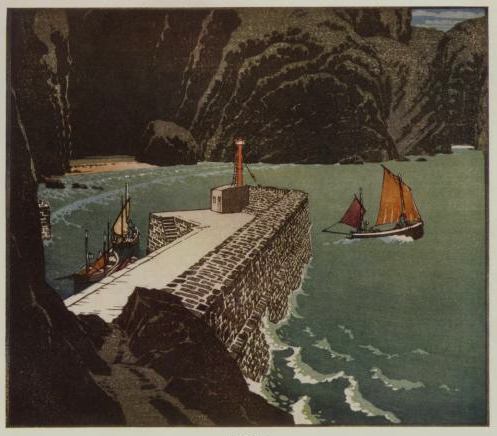
John Edgar Platt – Mullion Covemore here

John Edgar Platt, Red Bull - more here
Source: http://woodblock.com/platt/
John Edgar Platt – The Echoing Shoremore here
Source: http://woodblock.com/platt/

Most of the above works were acquisitions from 1932 or 1933.

Works acquired by the CAS by Robert Austin and Douglas Bliss can be seen below.

Robert Austin, Still Life, Perugia, etching, 1932, Minneapolis Institute of Art. Gift of Robert Austin's Daughters Rachel and Clare 2013.70.37. A version of this print was acquired by the Contemporary Art Society in 1933 and gifted to the Victoria and Albert Museum.
Source: Minneapolis Institute of Art.
Douglas Bliss, Wandering Willie's Tale, from The Devil in Scotland.
Source: Collection of the author.

Douglas Bliss, Thrawn Janet image from the Title page, from The Devil in Scotland.
Source: Collection of the author. A book featuring prints from the Devil in Scotland was given to the British Museum by the Contemporary Art Society in 1934. Whether this book was included in the exhibition at Blackheath School of Art is unknown.
Having Blackheath as one of the venues for this touring exhibition was a coup for the students of the school and the locals alike. John Platt's contacts in the art world enabled him to organise interesting exhibitions during his time as principal from 1929 to 1940. This is intended to be the first in a series of entries on the exhibitions held at the Blackheath School of Art in the 1930's.


[1] ‘Loan exhibition of recent acquisitions of the Contemporary Art Society’ in Blackheath Local Guide, 17 February, 1934, p 11. The concluding passage of Dodd’s opening speech advised students that whilst looking at the drawings on display ‘that the best drawing was the one they saw with their minds’ eyes before they began to touch paper, for it was extremely difficult to do anything in a perfect manner.’
[2] loc. cit., p. 10.  Students were able to use their analytical skills to ascertain the technical skills which would have been very valuable for their development.
[3] Contemporary Art Society Report, 1934 - 1935, p. 29. The exhibition featured over 100 prints and drawings which were recent acquisitions.
[4] loc. cit., p. 30. I am unsure as to whether this work was acquired pre Feb 1934 for it to be included in the exhibition.
[5] Contemporary Art Society Report, 1932 – 1933, p. 33. Whether the CAS acquired two versions of Mullion Cove (one in 1932 and the other in 1934) is yet to be ascertained.
[6] loc. cit., p. 34. Robert Austin taught at BSA in the mid 1920’s.

Monday, 19 March 2018


Meryl Watts: Master Printmaker


Born Eveline (Evelyn) Meryl Watts in 1910 to Charles and Eveline Watts, Meryl Watts had a long association with both the Blackheath Conservatoire of Music and the Blackheath School of Art.[1] The first connection I discovered was that she was a student at the BCM, specifically as a programme seller for the performance of Prunella on Wednesday 26 May 1926 at the Blackheath Concert Hall. Looking through the few student and teacher lists in the archives they revealed that Watts had lessons at BCM as early as 1919.[2] In 1919 Watts and her father Charles both had lessons, Meryl undertook Physical Exercise with Miss Laura Pearson and her father, Charles, piano with Gayle Gardner. At this point in time they were still residing at 34 Oakcroft Road. Meryl received tuition for both piano and physical education. Her teachers were Gardiner until halfway through the Spring Term 1928, Miss Laura Pearson (physical education), and Hindley from midway through the Spring Term 1928 (piano).[3] Watts was also involved in community events, having designed a programme for a Barnardo’s Homes fete in Blackheath.[4]


Prunella Programme, Blackheath Conservatoire of Music, 1926.


Meryl and Charles Watts, Blackheath Conservatoire of Music, Autumn Term 1919.


Meryl Watts, Study for a Woodcut (Angel Fish), gouache on cardboard.
Source: Collection of the author.


It is clear that John Platt held Watts’ work in high regard as a number of her woodcuts appear in his collection.[5] As Platt regularly invited artists and students who were interested in the colour woodcut technique this was not proof in itself that Watts was a student at the school. Proof of Watts being a student at the school can be found in a number of Blackheath Local Guide editions. My first encounter with her as a student at the school was in the Blackheath Local Guide of 22 April 1933. A woodcut print by Watts included in the exhibition at the New Argosy was selected as one of the prints of the year by the Society of Graver Printers.[6] Watts’ colour woodcut print, Angel Fish was singled out for praise in the 1933 students’ exhibition and during this academic year she won a prize for colour woodcut.[7] Additionally, according to the Blackheath Local Guide, Watts won an award for Vacation work during the 1934-35 academic year.[8]


Meryl Watts, The Mad Hatter, woodcut, mid 1930's.
Source: Liss Llewellyn Fine Art
Meryl Watts, The White Rabbit, woodcut, mid 1930's.
Source: Liss Llewellyn Fine Art


Watts produced some woodcuts from Alice in Wonderland during her time at BSA. Whilst this has been a favourite subject of artists since Lewis Carroll’s first edition, which he illustrated, it would be nice to think that events at the school may have inspired Watts’ choice of subject matter. Beryl Laverick, a student at both BCM and BSA, starred as Alice in Wonderland in the West End in 1933.[9] This must have caused quite a bit of excitement at both schools and Douglas Bliss remembers the classes that Laverick attended being interrupted by photographers and various suitors.[10] I would love to think that Watts’ woodcuts of The Mad Hatter and The White Rabbit were inspired by the events at BSA and BCM at this time.


By 1936 the school had become renowned for tuition in the art of the colour woodcut under Platt. In an article entitled ‘The Colour Woodcut in Blackheath’ Alan Seaby referred to Platt’s mastery of the medium stating that; ‘There is no doubt that in your hands the wood print has been raised from its former status.’[11] The same article continued by extolling the work of some of the students who featured in an exhibition of the Society of Graver Painters in Colour. Pictures by Miss Doris Boulton, Mr J Milner and Watts were described as ‘show[ing] the possibilities of clear, telling colour in this medium’.[12] In the review of the 1936 prize giving there is reference to a work purchased by the Ministry of Education in Czechoslavakia whilst on exhibition there with the British Council.[13]

The school at this time became renowned as a centre of excellence in the field of commercial art under the expert tutelage of Charles Paine:
‘In recent years the Blackheath School of Art has taken the foremost place as the centre for training in commercial art, the design classes being under the instruction of the well-known artist-designer, Mr Charles Paine.’[14]
Also in 1936 Watts was one of two Blackheath students who won three first prize awards for an LCC competition of Commercial Art in conjunction with the manufacturers of Viyella Fabrics Messrs William Hollins and Co Ltd.[15]


Meryl Watts, Chameleon, colour woodcut, 1938.
Source: www.merylwatts.co.uk 


The Contemporary Art Society acquired Watts’ Chameleon in 1938 which was an extraordinary achievement for an art student who was not yet an established artist.[16] At this time the CAS also acquired works by Platt, highlighting the critical interest in her works. This technique and her chosen subjects were most definitely influenced by Paine and Platt. It is also quite probable that Watts influenced her teachers as has been convincingly highlighted in the excellent Modern Printmakers blog. More can be read here

In a number of exhibition reviews in the mid 1930's in The Scotsman Watts' works were praised by the 'London Critic'. These exhibitions included The Annual Society of Graver Printers in Colour at Walker's Gallery in 1936, The Society of Women Artists at the RI Gallery in 1937 and the annual exhibition of The Society of Graver Printers in 1938. The Scotsman's critic at the time was none other than Douglas Percy Bliss, who taught at the Blackheath School of Art (see previous entries for more on Bliss at BSA), and he would have been familiar with Meryl Watts and her colour woodcuts.[17] 

Works by Watts were also displayed in the Royal Academy exhibitions.[18] In the 1938 edition of the exhibition the following work by Watts was included:  Chestnut Roaster featuring ‘a bowed old man pushing his barrow.’ That this work was described immediately after those of her teacher, Platt – The Plough and Lapwings, cannot have been a coincidence, especially as The Plough’s snow setting certainly influenced Watts’ depiction of the Chestnut Seller against a harsh winter landscape.[19]  Looking through the excellent www.merylwatts.co.uk there are designs for a Blackheath Art Group logo. The development of this emblem bears a resemblance to the logo used on the cover of the 1934 prospectus and also to later advertise courses and exhibitions in the later mid 1930’s.
.
Meryl Watts, Entrance, Portmeirion, No. 3 Black and White series, hand-coloured by the artist?
Source: Collection of the author.


Watts left Blackheath in 1939/1940 and moved to Wales with her family. It was whilst in Wales that she created some of the images that she is perhaps best remembered for, black and white woodcuts of Portmeirion which were later made into postcards. Some of these postcards are on display in the Waiting Room of the Conservatoire. This technique was also used to great effect in the beautifully illustrated This Year’s Roundabout published in the mid 1950’s.

Sadly Watts never returned to Blackheath although the view, northwards, down towards the village from Lee Park was immortalized through her woodcut depicting the view both in Spring and Winter. Entitled Blackheath Village this colour wood block print was included in the Royal Academy Summer Exhibition in 1934.[20] It was also described in the 1933 students’ exhibition review:
‘Of much local interest was Miss Meryl Watts’ colour-print of Messr Hinds’ shop viewed through the trees of Lee Park.’ [21]
Meryl Watts, Blackheath Village, colour woodcut, 1933.
Source: www.merylwatts.co.uk

Blackheath looking northwards from Lee Park to Blackheath Village, early 1900's. Hinds is the building on the right side of the street.
Courtesy of the Blackheath Society Archives. Thanks to Allan Griffin for his assistance.


Even today, if you stand by the red post box on Lee Park you can still look down to see the general view Watts adapted pictorially for the finished image. On the right hand side in a brilliant Autumnal red brick of what was, at the time, Hinds and Co. The shopfront was set forward from the main building onto the pavement of Lee Road with its awning standing out in the picture from the redbrick façade. The building most recently housed Costcutter although it is now empty.  To the right of Hinds and Co can be seen the garden of the Conservatoire behind a wrought iron fence although the building is not visible. In the distance a church spire, which is most likely All Saints, can be seen from the top end of Lee Park, although it is not visible from this spot today.

Meryl Watts, Self Portrait, 1930's.
Source: www.merylwatts.co.uk
Blackheath School of Art students standing outside the art building mid 1930's. Meryl Watts is the student to the far left of the foreground.
Picture courtesy of the Blackheath Society Archive. Thanks to Allan Griffin for his assistance.

A photograph from outside the art school and extension survives which most likely dates from the mid 1930’s. This is an image depicting Blackheath School of Art students and so far the only student I have only been able to identify is Watts to the far left. A self portrait painted in the 1930’s looks very much like the woman in the photograph.
I am looking forward to reading more about Watts in the forthcoming book on colour woodcuts by Gordon (of Modern Printmakers fame). Hopefully the above information and her fantastic woodcut prints will enable her legacy and important contributions to both the BSA and local community to live on.


[1] Watts was listed as Eveline Meryl Watts in the 1911 census living at 34 Oakcroft Road SE13. The spelling of her Christian names varies as she also appears as either ‘Eveline’ or ‘Evelyn’ Meryl Watts in the 1930’s Electoral Rolls. She must have been known as ‘Meryl’ not to be confused with her mother.
[2] BCM Students’ payment register 1919. The Summer Term payment records show that Meryl had lessons with Miss Pearson and that the fees were paid by her mother Eveline. Meryl’s had twelve 20 minute lessons for the term. Her father, Charles, took up piano lessons with Gayle Gardner in the Autumn Term 1919.
[3] BCM students’ payment register, 1928. The register shows the payment being split equally between Gardiner and Hindley.
[4] Blackheath Local Guide, 4 July 1936, p. 6. ‘The programme for the fete bore a special cover designed by Miss Meryl Watts.’
[5] Thanks to Platt’s granddaughter, Liza, for kindly showing me what remains of his collection and also a comprehensive list of the pictures that formed a part of his collection. The fourteen works by Watts include: Blackheath Village (from Lee Park), Pelican, Chameleon, Mad Hatter’s Tea Party, Cactus, Two White Rabbits and Man Pushing a Cart with a Brazier.
[6] ‘Blackheath Artists’ in Blackheath Local Guide, 22 April 1933, p. 12. The article refers to an exhibition held at the New Argosy in Blackheath Village which included works by a number of students. The work by Watts which was singled out was Flower Woman.
[7] ‘Blackheath School of Art: Annual Exhibition of Students’ Work and Prize Distribution’ in Blackheath Local Guide, 22 July 1933, p. 28. Angel Fish was described as possessing ‘delicate evanescent tones’.
[8] ‘Blackheath School of Art: Exhibition of Students’ Work and Prize Distribution’ in Blackheath Local Guide, 27 July 1935, pp. 26
[9] A drawing by William Haselden for Punch, now in the V&A, records the cast for Alice in Wonderland at the Little Theatre 1933 (S.1744-2014).
[10] DP Bliss letter to Neil Rhind, 6 April 1981. Bliss wrote in his letter, ‘She was acting as alice in A in Wonderland when she joined my class. It was once or twice interrupted by Beryl’s “sugar daddies” and press photographers.’ – 28.
[11] ‘The Woodcut in Blackheath’ in Blackheath Local Guide, 19 December, 1936, pp. 58 – 59. The author quotes an article in The Artist on Platt’s woodcuts and also refers to an article in the Observer in which the author Jan Gordon refers to the ‘distinguished simplicity of Platt’s work in the medium’. The article also features reproductions of Lamb by John Platt and a portrait of him by his son Michael.
[12] ibid. The work by Doris Boulton was ‘Dog’s Holiday’ described as ‘full of vitality’ and by Milner ‘Bridge’ as being ‘powerful in design’. Platt later became President of the Society of Graver Painters in Colour in 1938, holding the position until 1953.
[13] ‘Blackheath School of Art: Prize Distribution and Private View of Students’ Work’ in Blackheath Local Guide, 4 Jul 1936, p. 36.
[14] ‘Commercial Art at Blackheath School of Art’ in Blackheath Local Guide, 14 March, 1936, p. 33.
[15] ibid. The other student was Roy Stone and between them they shared £28 of the £48 available in prize money.
[16] Blackheath Local Guide, 1 January, 1938, pp. 27-28. The article regarding a prize giving for 1937 mentioned that Meryl Watts, a student of the Colour Woodcut class had a work purchased by the Contemporary Art Society.
[17] Bliss, D.P., 'Art in London: Colour-Prints' in The Scotsman, 14 Dec 1936, p. 13, Bliss, D.P., 'Art in London: Several Interesting Shows: Women Artists' Show' in The Scotsman, 21 Jun 1937, p. 13 and Bliss, D.P., 'Art in London: Graver Printers' Show: Notable Contributions' in The Scotsman, 10 Dec 1938, p. 10.
[18] Blackheath Local Guide, 7 May, 1938, p. 3. A brief list includes Meryl Watts amongst people connected with the school included in the RA Summer Show.
[19] loc.cit., p. 32. Also on pages 31 and 32 of the same edition (see note 3) there is a more detailed article of works from artists connected with Blackheath.
[20] Blackheath Local Guide, 5 May 1934, p. 7. The article lists works by students and teachers at the school.
[21] ‘Blackheath School of Art: Exhibition of Students’ Work, July 1933’ in Blackheath Local Guide, 22 July 1933, p. 23.